Data Migration Calculator
Migrating historical accounting data from a legacy accounting system to a dimensional accounting system like Sage Intacct is not a simple copy-and-paste exercise. It’s a complex process involving data extraction, data cleanup, data mapping, data conversion, and data loading to fit the target system’s dimensional architecture, with data validation at every step.
How Does This Data Migration Calculator Work?
This calculator estimates the number of staff hours it would take to complete a migration of historical accounting data from a legacy platform like QuickBooks to Sage Intacct, based on the number of company files you would like to migrate.
For example, for our customer Coppermine Capital, who had 95 QuickBooks files, we estimate that partnering with our company saved their staff of three at least 9,500 hours.
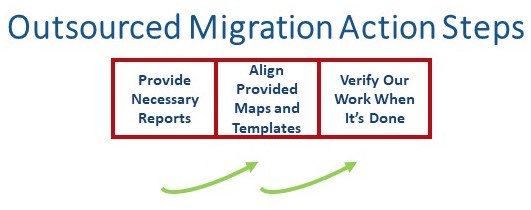
Calculation of hours is conservative, volume adjusted, includes up to 100k lines of data per file, assumes that the data is well-formatted, assumes that you know which reports are necessary to pull, and that you are solely focused on the data migration uninterrupted.
Why is Data Migration Time-Consuming?
Preparing your legacy data for an accounting platform migration needs to be done with care, and can be slow going, especially if it’s your first time going through an application migration. But in most cases, the most time-consuming step in an accounting data migration is dealing with the errors that get triggered by all the edge cases you miss when you use generic import templates. These templates reliably lead to data import errors, which need to be corrected one-by-one.
Many Value Added Resellers (VARs) that perform data migrations as part of a Sage Intacct implementation charge hourly for error correction. This means they’re not incentivized to prevent those errors on the front end.
At Platform Transition, we take a different approach. We charge a flat fee for our accounting data migration services, which means we’re incentivized to prevent and mitigate all sources of errors, with a particular focus on import errors. To do so, we’ve developed a rigorous QA process. In fact, our 10-step data migration process includes five distinct validation steps. This helps us programmatically prevent errors on the front-end. If errors surface during our QA steps, we identify the root cause of those errors and make sure to fix it before moving to the next step. This process often leads to an error-free migration.

Consider: What will attending to the migration internally cost your business
- In missed opportunities?
- In time?
- In resources?
- In headache?
Benefits of Outsourcing Data Migration
Accounting teams face enough challenges during a migration to a new accounting platform. Outsourcing data migration to a trusted partner lets you focus on designing the new architecture and relearning all of your reporting workflows. And while saving staff time on the migration itself is a compelling benefit of outsourcing, the real benefits come from the confidence you gain in your data and the ability to reliably meet your go-live deadline.
Meet Your Go-Live Deadline
Missing a go-live date creates real business risk. If your finance team can’t produce required reports tied to bank covenants or lender requirements, you can trigger a technical default — even if every payment goes out on time. Private equity partners may delay funding or raise concerns about controls and reporting maturity. Operationally, a missed go-live often leads to stalled closes, manual workarounds, frustrated teams, and a loss of confidence in the new system before it’s even fully live. In heavily regulated environments, those failures can escalate into compliance or legal challenges.
Platform Transition’s Modular Go-Live eliminates that risk by separating what must be live on day one from what can be safely migrated later. We ensure that the data required to support critical reporting, audits, and operational workflows is available at go-live, while the remaining historical data moves over methodically and without unnecessary pressure. Your team meets its deadlines, your stakeholders get the reports they expect, and the broader migration continues without compromise.
Gain Confidence in Your Data
At Platform Transition, we’ve honed our migration process around one goal: giving you complete confidence in your accounting data. From our master data cleanup processes to our data migration validation steps, everything we do is designed to provide clear, objective proof that the data in your target system is trustworthy. Research shows that the added confidence you and your team gain in the quality of your data can boost user satisfaction and adoption rates with the new software, leading to a faster ROI.
Save 80% of Staff Time on Data Migration by Partnering with Platform Transition
We’ve performed more than 2,900 historical accounting data migrations to Sage Intacct from more than 80 legacy software systems. Our clients tell us that working with us saves them about 80 percent of the time/effort it would take to complete their migrations on their own.
Our data migration process is designed to give you complete confidence about the quality, accuracy, and completeness of your data migration at every single step of the process.
With our flat-fee model and commitment to getting it done right the first time, you can have total confidence in your data migration. Ready to experience a seamless transition to Sage Intacct? Schedule your strategic exploration call or request a quote today to get started.
Leveraging Platform Transition Data Migration Services saves clients approximately 80% of the time/effort calculated above.